Windshield time is one of the most persistent drains on trade margins. When technicians spend hours crossing congested metro corridors, you pay full hourly labor and vehicle wear without billing a dollar. However, attempting to squeeze minor repair stops into a packed day without calculating travel and buffer costs can backfire, causing missed arrival windows on major projects.
The true arithmetic of travel time and mileage#
To evaluate whether a detour is profitable, you must track both vehicle operating costs and fully burdened labor rates rather than fuel alone:
- Burdened Crew Labor: A two-person technician team earning $30/hour and $20/hour has a combined fully burdened cost (including payroll taxes, workers’ comp, and benefits) of roughly $88/hour, or $1.47 per minute of travel.
- Vehicle Fleet Expense: Fuel, maintenance, tires, commercial auto insurance, and vehicle depreciation average approximately $0.75 per mile for standard service vans and utility trucks.
- Cross-Town Trip Cost: A 15-mile, 30-minute transit across town incurs $11.25 in vehicle wear and $44.10 in crew labor—a total of $55.35 in unbillable travel cost before the technician steps out of the cab.
A worked before-and-after route comparison#
Consider an electrical contractor with two scheduled installations on a Tuesday:
- Base Schedule: Morning 200A panel upgrade (8:00 AM – 1:00 PM) in Oak Hills. Afternoon EV charger installation (2:00 PM – 4:30 PM) in Northwood, 10 miles away.
- The Opportunity: A homeowner 1.2 miles from the morning job submits an online request for a GFCI outlet diagnostic and replacement.
- Incremental Detour Cost: 1.2 miles additional driving ($0.90 vehicle cost) + 8 minutes transit ($11.76 labor) + 35 minutes on-site service ($51.45 labor) + $15 in materials = $79.11 total incremental cost.
- Collected Invoice & Net Contribution: $185 diagnostic and receptacle replacement fee. Subtracting $79.11 incremental cost yields $105.89 in positive contribution margin toward overhead, completed inside the midday transit window without disrupting the afternoon project.
When to decline a stop: The rush-hour trap#
Illustrative Example: A Detour to Decline
A request arrives for a $95 single-switch replacement located 4.5 miles off route. However, reaching the address requires navigating a notorious highway bottleneck during 4:15 PM rush hour. The detour would add 35 minutes of transit time plus 25 minutes on site (60 minutes total). The incremental labor cost alone ($88) plus vehicle expense ($3.38) wipes out the $95 ticket, while risking crew overtime or delaying a scheduled $8,000 whole-home rewire walkthrough. In this scenario, declining or rescheduling the call to a dedicated service day is the correct operational choice.
Why human approval must remain in the dispatch loop#
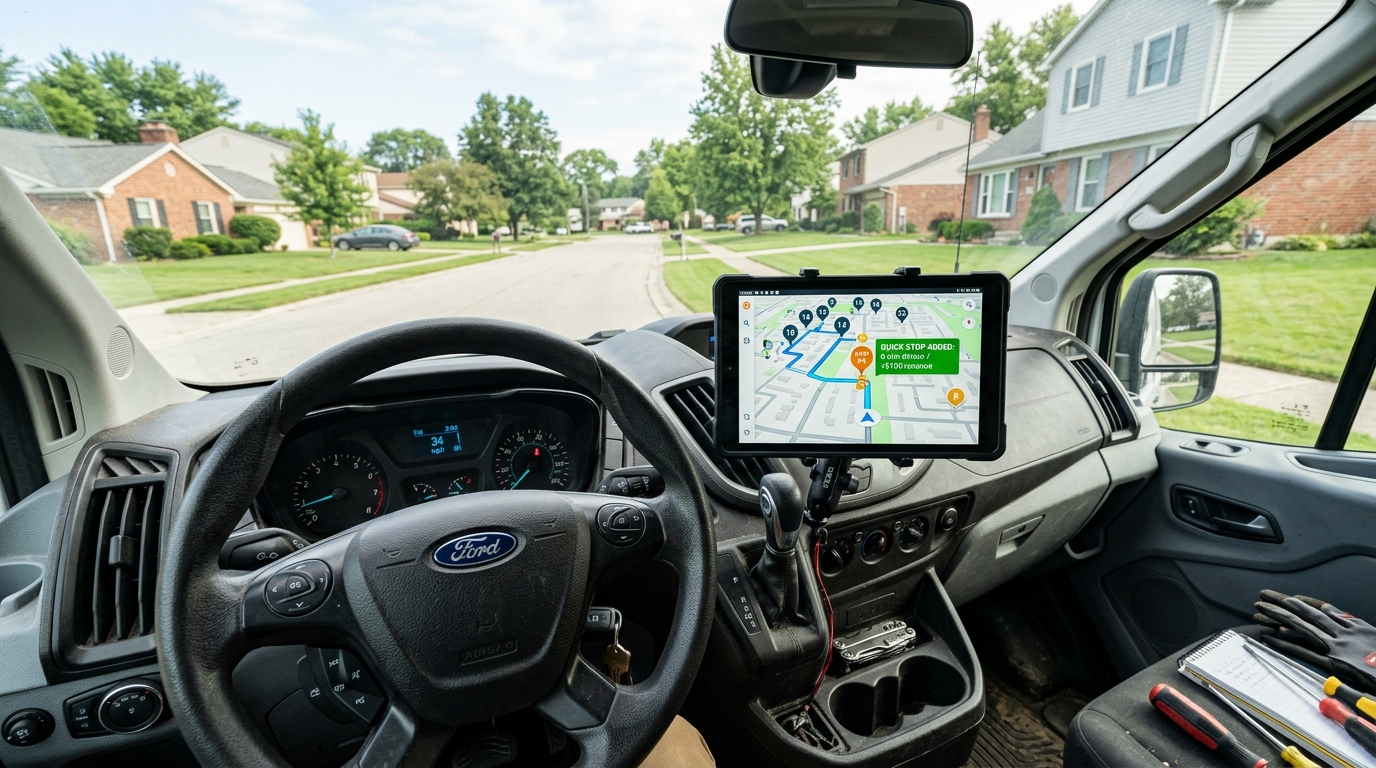
Automated dispatch tools can identify geographic proximity, but software cannot see whether your truck has the exact replacement parts in stock or whether a morning technician is running behind schedule. Software should flag high-margin proximity opportunities, but your dispatcher or lead technician must retain final one-click approval before altering active routes.
Let’s Get Quoted’s Quick-Stops feature highlights nearby customer service requests within your customizable mileage radius, providing travel time estimates and fee calculations so your team can make informed scheduling decisions.