When a residential contracting business expands, bringing on an apprentice or an extra seasonal laborer is a milestone. You calculate wages, workers’ compensation, and tool allowances. But when you add them to your dispatch calendar, many trade management platforms add an unexpected line item: an additional $29 to $49 per user every single month.
The contractor seat-audit worksheet: Mapping software use to actual roles#
A flat per-seat charge treats every team member as an equal software consumer. In practice, software utilization varies drastically across your roster. Before adding or paying for additional user licenses, audit how each role interacts with your system:
- Owner / Estimator (High Usage): Builds multi-tier proposals, configures pricing catalogs, runs financial reports, and issues change orders. Interacts with software 3–5 hours daily. Requires full administrative permissions.
- Office Dispatcher / CSR (High Usage): Handles inbound calls, assigns technician routes, confirms arrival windows, and processes payments. Interacts with software continuously throughout the workday. Requires scheduling and customer management access.
- Lead Field Technician (Moderate Usage): Checks daily route, updates job statuses, logs parts used, and captures completed site photos. Interacts with software for 15–30 minutes across a typical workday.
- Apprentice / Seasonal Helper (Minimal Usage): Primarily performs physical installation and material staging. Only needs to know the morning job address and punch an accurate timesheet. Software interaction is under 5 minutes daily.
Illustrative Scenario: The Seasonal Helper Cost Penalty
Consider a 3-truck plumbing business with an owner, an office dispatcher, two lead techs, and two summer apprentices (6 total users). On a plan charging $45/user/month, the business pays $270/month ($3,240/year). Paying $90/month for two apprentices who only check an address and clock in adds $1,080 annually in software overhead for basic operational communication.
The operational risks of credential sharing#
When software charges steep per-seat fees, trade owners frequently try to work around the cost by sharing logins across multiple trucks or texting customer details via SMS. While understandable, credential sharing introduces concrete business liabilities:
- Compromised Audit Trails: If multiple technicians share a single “Tech Truck” login, determining who captured customer sign-off or recorded specific material quantities becomes guesswork.
- Security & Access Gaps: When a temporary employee or subcontractor leaves, shared passwords must be changed across every company device to prevent unauthorized access to customer records.
- Communication Delays: Field technicians without individual accounts cannot receive direct job notes, attachment updates, or automated route arrival alerts.
Comparing pricing structures: Per-seat vs. capacity vs. platform pricing#
Different software providers structure their costs to fit different business types. Evaluating the fit requires calculating your annual expense under your expected staffing variations:
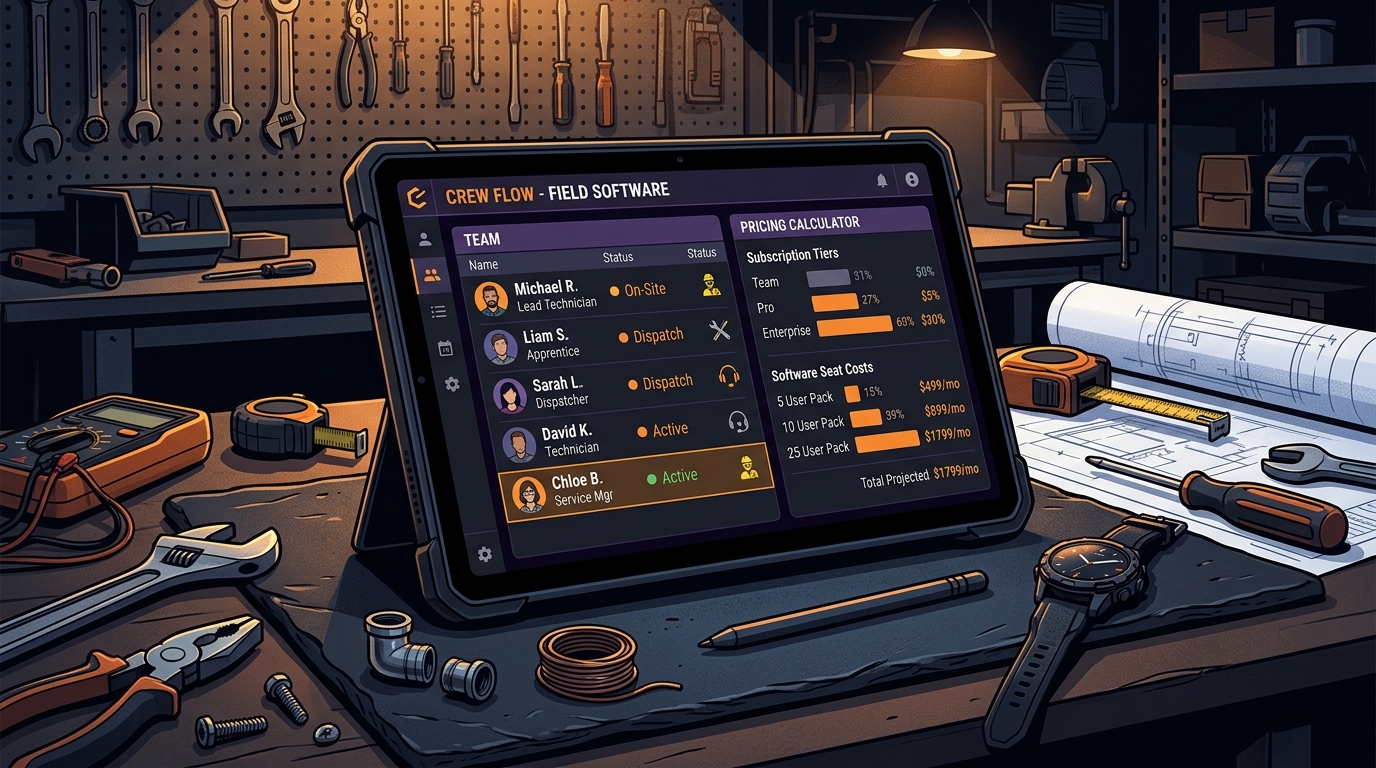
- Per-Seat Subscription: Charges a fixed monthly fee per active user login. Predictable if headcount never changes, but can penalize businesses that bring on seasonal helpers or apprentices.
- Tiered User Bundles: Software includes a set allocation of users (e.g., up to 5 users on a mid-tier plan) before tier upgrades are required. Economical if your team count sits comfortably within the threshold.
- Platform-Aligned Pricing: Base software includes generous field crew and office seats with low $5/mo add-ons, pairing core tooling with transparent activity- or transaction-based platform fees as revenue is collected.
At Let’s Get Quoted, we believe operational communication should never be priced out of reach. Every plan includes dedicated office and field crew seats, plus affordable $5/mo field logins so your entire team stays aligned on schedules, customer notes, and site photos without enterprise subscription bloat.