
See money before it moves
Deposits and balances you are owed, installments due, recurring visits ahead, payroll from logged hours and the bills you enter — all dated, all applied forward from what is actually in the account today.
Cash flow + insights
Deposits and balances you are owed, payroll and bills you owe — dated and projected forward from today’s balance. The week you cannot cover payroll becomes a warning rather than a Friday morning discovery.
Built from money the product already knows about: approved quotes, deposits, installments, recurring visits, logged hours and the bills you enter. Nothing here is a guess about your industry.
Next 14 days · projected
Below buffer FriA dip is only told to you when it is close enough to act on — inside 7 days — and stays quiet otherwise. A warning you have to go looking for is not a warning; one that fires every day is not either.
Invented figures. What is real is the method: every line is a dated movement of money, and the balance is those movements applied in order to what you have today.
The number that decides whether you take the job
A job can be worth doing and still be the thing that empties your account, because the materials go out three weeks before the balance comes in. A forecast built from the deposits, installments and payroll the product already holds turns that from a feeling into a date — and a date is something you can move a bill or chase a balance against.
The cash flow and forecasting engine
Dated balances, confirmed vs expected revenue, automated buffer alerts, and CPA-ready reports.
Dated movements of money applied forward from today’s balance. See deposits arriving, supplier bills, and crew payroll in one timeline.
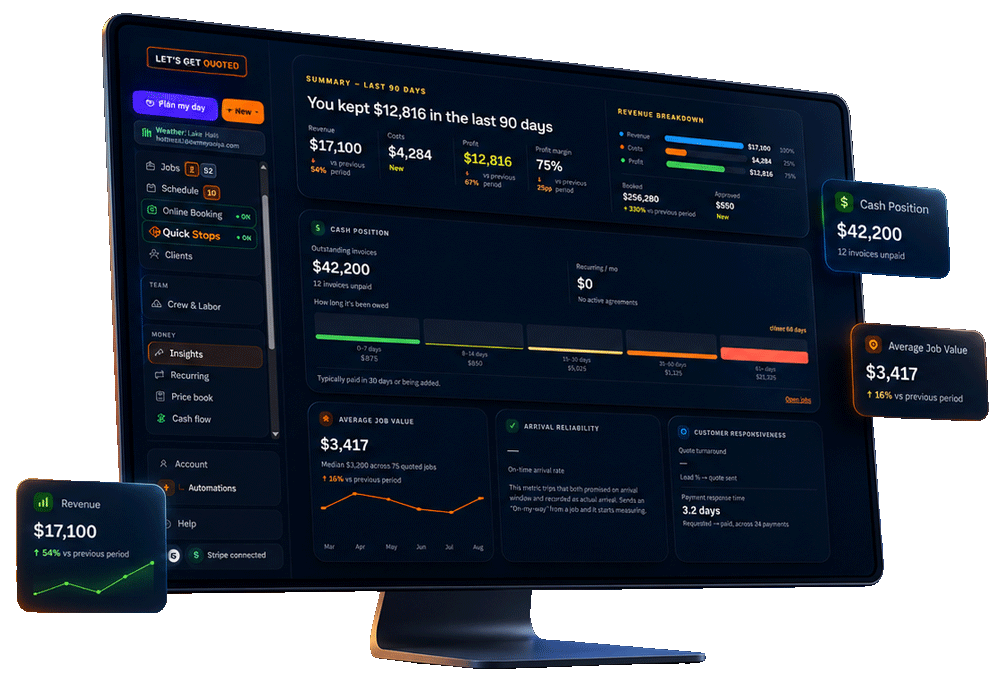
Hard deposits in hand are kept strictly apart from pending balances. Read realistic conservative cash positions without doing spreadsheet gymnastics.
The engine warns you when a projected balance will dip below your safety threshold within 7 days, giving you time to chase a balance or stage a vendor invoice.
Cash-basis profit and loss by year, expenses categorized by trade code, and QuickBooks-ready CSV files built from original job records.
From records you already have
One starting balance and the buffer you never want to go under. Everything else is projected from records the product already holds.
Approved deposits, balances due, installment dates and recurring visits — with a late allowance, because customers are late and a forecast that assumes otherwise is fiction.
Payroll from hours actually logged, plus materials, equipment, loans, tax and any bill you enter with a date on it.
The forecast names the day you cross your buffer. It tells you inside a week, and stays quiet the rest of the month.
What it can tell you
Built from the same job records the quotes, the crew hours and the payments ran on, which is why none of it needs reconciling before you can trust it.
Know your numbers and hand clean books to your accountant.
4 of 136 things the platform does. See all of them.
Before you start
No. You tell it what is in the account today, and it projects forward from money the product already knows about — approved quotes, deposits, installments, recurring visits, logged hours and bills you enter. That means no bank credentials to hand over, and a forecast you can explain line by line.
With an explicit late allowance rather than by pretending everyone pays on the day. Confirmed money and expected money are also kept apart, so you can read the pessimistic version without doing the arithmetic yourself.
No. A dip is worth telling you about when it is close enough to act on, so the warning fires inside 7 days and stays quiet otherwise. It also goes quiet when the balance you gave it is old enough to be about a different month.
It is a forecast and a set of reports, not a ledger. It will give your accountant a cash-basis P&L, expenses by category and an import-ready QuickBooks CSV — it will not do double-entry bookkeeping or file anything for you.
Included on every base plan. Flex starts at $0/month plus a 1.25% LGQ platform fee. Solo, Growth, and Scale add a base subscription and lower that fee to 0.50%, 0.25%, or 0.10%. Cash-flow visibility has no separate add-on price. Stripe's processing and payment-infrastructure costs set by Stripe are separate.
✦ THE FULL CONTRACTOR SUITE IS READY
Create your site, qualify better leads and run every job from one place.
Create My Free Account →No card required · Flex starts at $0/month + 1.25%